- Magento, Magento B2B
Three quotes, three very different prices: what an Magento B2B online store costs
Three agencies, the same request for a B2B online store, and three quotes that differ by tens of thousands of euros. That’s not an exception. Building a Magento B2B web shop typically costs between 50,000 and 150,000 euros, and that difference rarely lies in the agency’s margin.
It’s in what is—and isn’t—in the quote. Who builds the ERP integration. Who cleans up the product data. What happens once the store goes live. A quote for 50,000 euros and one for 150,000 euros often refer to two different projects that just happen to share the same name.
This article walks you through the areas where the money is, so you can see for yourself which part of the difference is due to scope and which part is something else.
Why three quotes for the same online store vary so widely
A quote for a B2B online store is the sum of various assumptions, and every agency makes different assumptions. The request usually states “integration with our ERP.” One agency charges for a standard product feed, while another charges for a two-way integration that includes customer-specific prices, inventory, orders, and credit limits.
The second area where quotes differ is the data. Transferring a catalog of ten thousand items from an ERP system to an online store is only a challenge when it turns out that the dimensions are stored in three different fields and half of the items lack a photo. In client meetings, data quality between the ERP and the online store is the topic that comes up most often—and it’s also the topic most frequently left out of the quote.
The third point concerns what happens after the site goes live. An agency that only builds the site may be cheaper than one that also handles maintenance. You won’t notice that difference in the quote, but you will in the first year afterward.
How much does it cost to convert a B2B online store at Magento ?
Building a Magento B2B online store typically costs between 50,000 and 150,000 euros. Within that range, four factors determine the final cost: how much customization is required, how many integrations are needed, the size and quality of the catalog, and the complexity of the front end.
The turnaround time for a B2B online store with customer-specific pricing, corporate accounts, and an ERP integration is four to six months. If additional integrations, multiple stores, or multiple countries are added, the timeframe increases to six to twelve months.
Those figures are not far off from what implementation partners report internationally. An independent benchmark by Elogic from 2026 estimates target costs starting at approximately 230,000 euros—converted from dollars—for a B2B project involving ERP, PIM, and multiple stores. That is higher than what you see in the local market, and that difference is mainly due to the fact that those projects more often include Adobe Commerce and a headless front end.
What these amounts are not: an hourly rate multiplied by a number of hours. A quote that mentions only an hourly rate and an estimated number of hours shifts the risk from the agency to you.
Which components drive up the price
Four items account for most of the difference between a quote of 50,000 euros and one of 150,000 euros.
Data integrations are the first step. A single feed from the ERP to the online store is a straightforward task. Prices per customer, inventory, orders, returns, and credit limits in both directions—with a system that determines who is correct when the figures differ—is a project in itself. Anyone who doesn’t answer that question up front will end up paying for it later.
Data migration is the second. Transferring old order history, customer data, and product data takes time, and cleaning up that data takes even longer than the transfer itself. The international benchmark sets aside a separate budget for data migration, ranging from approximately 9,000 to 46,000 euros, converted from dollars.
Multiple stores constitute the third scenario. A second language, a second country, or a second product range with its own VAT rules affects virtually every aspect of the project. The same benchmark estimates an additional 30 to 50 percent on top of the total cost for this.
Customization is the fourth—and the most treacherous—element. A product configurator, a quote process with approval, or a credit check at checkout are all reasonable requests that are discussed separately and together determine the budget.
How much does an Magento online store cost once it’s live?
The setup costs are a one-time expense; the rest are not. Magento receives security patches from Adobe approximately once a month, and each version has an end-of-life date: Magento 2.4.9 is supported until May 31, 2029, and 2.4.7 until May 31, 2027. An online store that isn’t kept up to date will eventually require a migration project.
A commonly used rule of thumb in the market is that maintenance costs 20 to 40 percent of the implementation costs annually. Based on a total project cost of 80,000 euros, that amounts to 16,000 to 32,000 euros per year. This is a guideline figure from the international benchmark—not a quote—but it is the order of magnitude you should expect.
In the Netherlands, these costs are increasingly presented as a fixed monthly fee rather than an hourly rate. At Factor Blue, management and maintenance start at 1,795 euros per month and increase if further development is required, as stated on the pricing page. Hosting is billed separately.
The aspect most often overlooked is ongoing development. A functioning B2B online store will give rise to new requirements within a year: an additional customer group, an integration with the shipping carrier, or a report for the sales department. Factor this into the annual budget, not the initial development cost.
Open Source or Adobe Commerce: How the Licensing Difference Affects Your Budget
Magento Open Source has no licensing fees. Adobe Commerce does, and those costs increase with your revenue. In practice, the licensing fees for Adobe Commerce amount to 25,000 euros per year or more. An independent benchmark estimates costs for the on-premise version at approximately 20,000 euros per year for revenue under one million, rising to over 115,000 euros for higher revenue figures, converted from dollars.
That difference is not a reason to advise against Adobe Commerce. It provides B2B functionality that would otherwise have to be built from scratch, plus support from Adobe. However, it is a recurring annual cost that is often omitted from comparisons between two quotes.
The honest cost calculation spans several years. A license costing 25,000 euros per year amounts to 75,000 euros over three years. For that amount, you could also have a substantial amount of B2B functionality built using open source, which would then belong to you. Which option you choose depends on how much of that standard functionality you actually use.
When a Magento B2B online store is too expensive for what you need it for
There are situations in which these costs are unjustifiable, and it is better to recognize them in advance rather than halfway through the process.
If you have a limited catalog with a single price list for all your customers, you’ll be paying for flexibility you don’t use at Magento . A simpler platform does that job for a fraction of the cost.
If there is no ERP system, or if that ERP system cannot be integrated, then the main reason for using Magento is lost. The benefit of this platform lies in the automatic synchronization of prices, inventory, and orders. Without a source system, you’ll still have to maintain everything manually, using a more expensive package.
If there is no annual budget for maintenance, then this is the wrong time. An 80,000-euro online store that remains untouched for two years will cost more during the next upgrade than what you would have spent on maintenance.
And if you need to go live within six weeks, this process isn’t right for you. Four to six months is non-negotiable—that’s the time it takes to build and test integrations.
How to Make Two Quotes Comparable
Back to the three quotes that differed by tens of thousands of euros. You can make them comparable by asking for the same six things from all three, rather than just looking at the bottom line.
- Which systems are linked, in which direction, and which system takes precedence in the event of a discrepancy
- What happens to the existing product data and order history, and who is responsible for cleaning it up
- How many customer groups, pricing tiers, and business accounts are included in the price, and what an additional group costs
- What the monthly management fee is after going live, and whether hosting is included
- Who owns the code if the collaboration ends
- Which portion is a fixed price and which portion is based on actual costs
Those last two points say the most. An agency that doesn’t transfer the code isn’t selling you a web store but a subscription. And a quote that consists mostly of post-project cost calculations isn’t a price but a starting amount.
If you’d like to have the results reviewed by someone familiar with the platform, request a code review or a second opinion before signing on. A review like this costs 2,500 euros with us, depending on the scope of the installation, and that’s cheaper than going down the wrong path.
How much does a B2B online store cost?
A B2B online store at Magento typically costs between 50,000 and 150,000 euros to build. The cost depends on the number of integrations, the amount of customization, the size of the catalog, and the complexity of the front end. A simpler platform with a single price list can be built for a fraction of that cost, but it does not offer customer-specific prices from your ERP.
How much does an Magento online store cost?
In practice, building a Magento online store starts at around 50,000 euros for a B2B environment with integrations. Simple B2C stores based on an existing theme cost less. In addition to development costs, there are hosting, maintenance, and ongoing development expenses, which together amount to 20 to 40 percent of the development cost annually.
How long does it take to build a Magento B2B online store?
Four to six months for a B2B online store with customer-specific pricing, corporate accounts, and an ERP integration. With multiple integrations, multiple stores, or internationalization, that timeframe extends to six to twelve months. Going live within six weeks is not realistic on this platform.
Does Magento charge licensing fees?
Magento Open Source has no licensing fees. Adobe Commerce does: in practice, 25,000 euros per year or more, increasing with your revenue. An independent benchmark estimates the on-premise version at approximately 20,000 to 115,000 euros per year, with these figures converted from dollars.
How much does it cost per month to maintain a Magento online store?
Management and maintenance of a Magento online store starts at Factor Blue at 1,795 euros per month and increases if further development is required. Hosting is not included in this price. The minimum contract term is six months, and you can cancel free of charge within the first three months.
How much does hosting cost for a Magento online store?
Hosting is separate from development and maintenance costs and depends on visitor numbers and catalog size. According to international benchmarks, managed hosting for a medium-sized online store costs around 150 to 1,500 euros per month, with these figures converted from dollars. A catalog with more than 100,000 items adds to that cost.
How much does an ERP integration with Magento cost?
An ERP integration does not have a fixed price, because there is a significant difference between a single product feed and a two-way integration involving prices, inventory, orders, and credit limits. Always ask which data flows in which direction and which system takes precedence if the figures differ. That single answer often explains the majority of the price difference between quotes.
How much does it cost to transfer my product data?
According to international benchmarks, data migration costs approximately 9,000 to 46,000 euros—guideline amounts converted from dollars. Cleaning up the data usually takes more time than transferring it. In every quote, explicitly ask who will do the data cleanup: you or the agency.
Can a Magento online store be cheaper?
Yes, by using fewer integrations, an existing theme, and less customization in the initial phase. The biggest savings usually come from delaying the development of functionality that isn’t immediately necessary. Cutting corners on the ERP integration or on cleaning up product data may seem profitable on paper, but it actually costs more in the first year than it yields.
What happens if I don’t spend anything on maintenance?
Then, within a few years, your online store will become a migration project. Adobe releases security patches roughly every two months, and every Magento version has an end-of-life date: 2.4.7 is supported until May 31, 2027, and 2.4.9 until May 31, 2029. A store that falls behind those dates will cost more during the next upgrade than the deferred maintenance would have.
Related articles
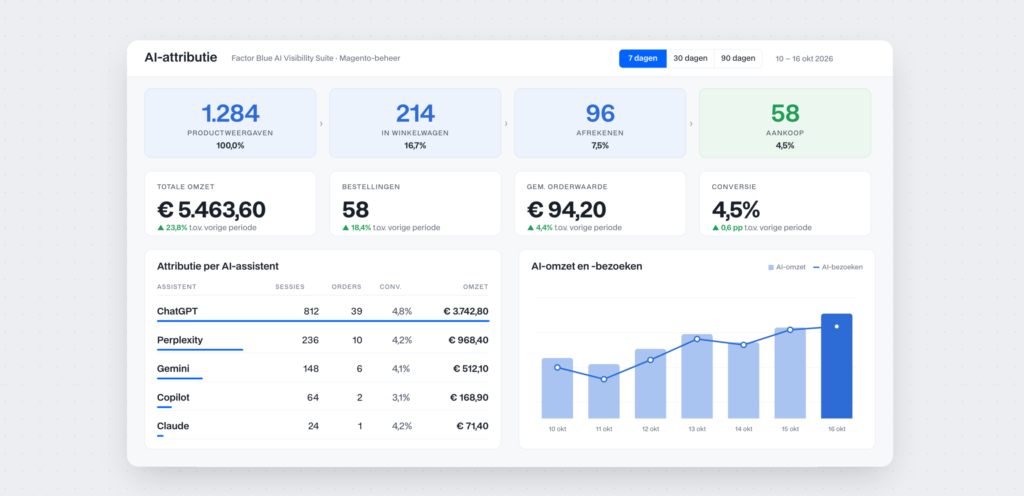
AI agents aren’t recommending your products? Here’s how to boost the visibility of your Magento online store

Worried that an update might break your Magento shop? Here’s how to safely update Magento extensions

What it really takes to have a product configurator developed within an organization


Done with your current agency: here’s how the transition of your Magento management works

The license is free, but the migration isn’t: what “ Hyvä ” means for your Magento online store

A Custom Price for Every Customer: What This Means for Your Magento B2B Online Store


Cloned in just a few hours: the number of AI-generated copies of online stores is growing

Digital Product Passport (DPP): What Does This Mean for Your Product Data and PIM?