Your Magento online store is ready for Claude, ChatGPT, Perplexity, and Gemini
More and more customers are asking an AI assistant which product to buy. The AI Visibility Suite makes your catalog readable by those assistants and shows you in your Magento admin panel how many visitors, orders, and revenue each AI generates for you.
According to Adobe, traffic from AI assistants to U.S. online stores grew by 393 percent in the first quarter of 2026 compared to the same period a year earlier. In March 2026, those visitors converted 42 percent better than visitors from other channels. Visitors who arrive via an AI recommendation have often already made up their minds.
Most Magento online stores are difficult for these assistants to read. Adobe reports that product pages in the U.S. retail sector score an average of only 66 percent on machine readability. This means that one-third of the content is lost amid menus, scripts, and formatting. Prices, inventory, and specifications are difficult for an AI crawler to distinguish from the rest of the page.
Why don’t I see AI traffic in Google Analytics?
AI crawlers do not execute JavaScript, so Google Analytics does not detect them. Visitors who click through from ChatGPT or Perplexity often enter without a referrer and are categorized as direct traffic.
As a result, an online store owner usually doesn’t know which AI assistant is reading their catalog, how many customers are coming in via AI, or what they’re ordering. With our module, we provide that insight within Magento.
The information is recorded with the order at checkout, even if the customer’s browser blocks trackers. By default, IP addresses are not stored, so it is GDPR-compliant.
If you use Google Analytics 4 or Tag Manager, the suite sends an ai_referral event along with the data, so your marketing team can see the signal there as well.
Our work is supported by a strong network of technical partners, complemented by expertise in e-commerce and technology that we continuously develop and refine.
The Factor Blue AI Visibility Suite is a set of four Magento modules that make an online store readable by AI assistants and measure the resulting benefits. Each module can be enabled or disabled independently and configured per store view, so a Dutch and a German store each receive their own content.
A current llms.txt
llms.txt is a text file conforming to the llmstxt.org standard that tells AI assistants what you sell and which pages matter. For each store view, the suite generates an llms.txt and an llms-full.txt containing your most important categories (including number of products and price range), your flagship products, your shipping and return policies, and an access policy for AI agents.
Every page is clean Markdown
For every product, category, and CMS page, the suite generates a Markdown version, accessible by adding .md to the end of the URL. An AI crawler then reads the title, SKU, price, inventory, specifications, and description without relying on menus or scripts. These versions are labeled “noindex,” so Google continues to index your normal page as usual, and you avoid the risk of duplicate content.
Structured data that AI understands
The suite adds schema.org data (JSON-LD) to product, category, and CMS pages: Product with price, inventory, and reviews; ItemList for categories; Organization and WebSite on every page; and FAQPage for frequently asked questions. This enables an AI assistant to answer a question such as “Does this store ship to Belgium?” using your own data.
Highlighting Revenue from AI
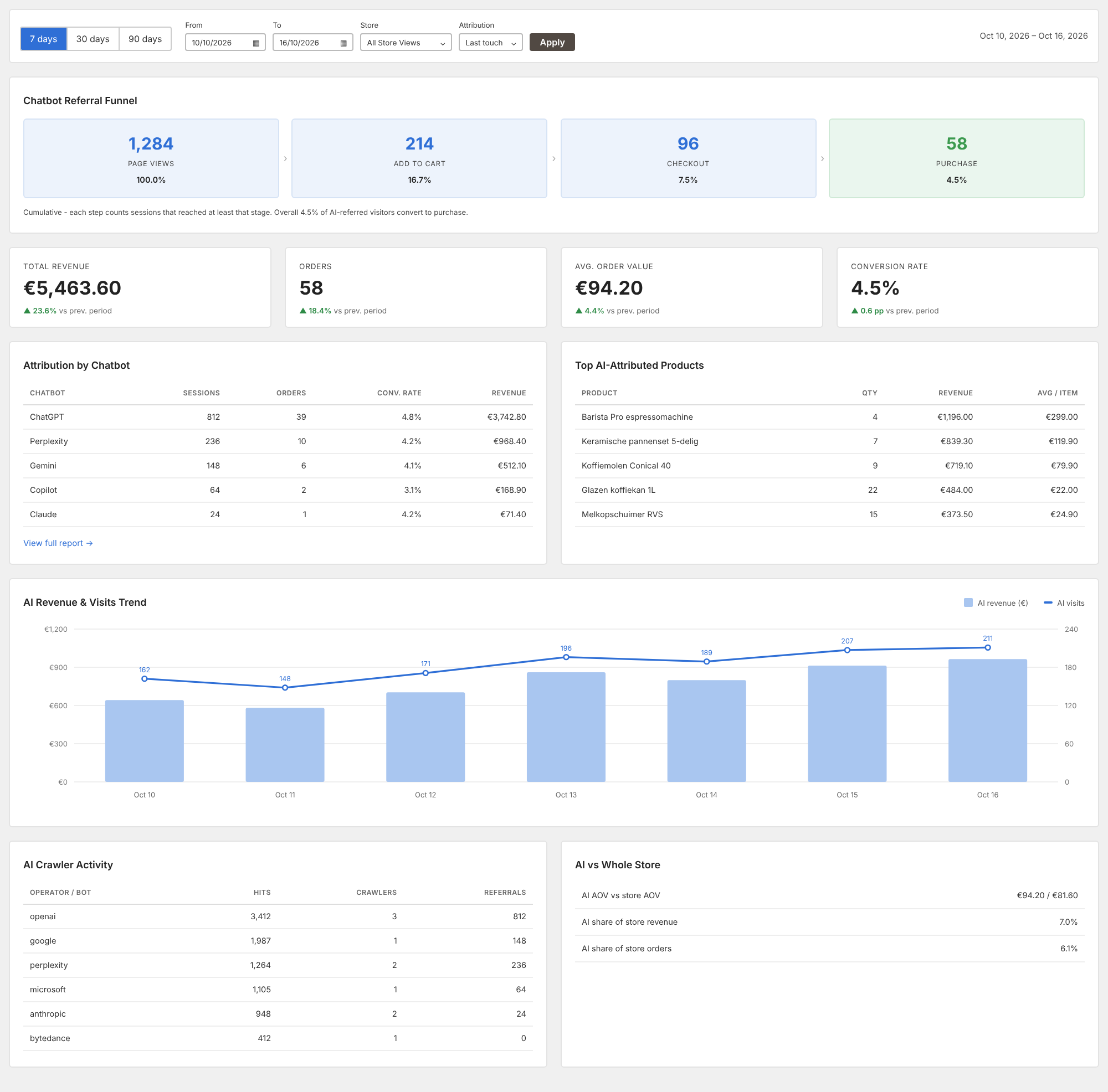
The AI Attribution dashboard displays three things in the Magento admin panel: which AI crawlers are scanning your products, how many people click through, and which orders result from those clicks. You’ll see revenue, orders, average order value, and the conversion rate per assistant—from ChatGPT and Perplexity to Gemini, Claude, and Copilot. An overview compares the AI share to the total revenue of the entire online store.
Trusted by ambitious brands
//04 — AI Ready with Factor Blue
Why choose Factor Blue for an AI-ready Magento online store?
Specialization
Not a general-purpose agency that dabbles in everything, but specialists who truly solve your complex challenges.
15 years of industry expertise
We know the ins and outs: large product catalogs, pricing and inventory logic for B2B and B2C, and data that has to be accurate. You don’t need to explain your market to us.
Direct communication, no interference
You’ll work directly with the developers. Honest feedback, clear agreements, and no surprises down the road.
Not just a time-billing agency, but a partnership
We help shape the roadmap, not just address today’s issues. Code that grows with your business instead of getting in your way later on.
TELL US WHAT'S GOING ON
We’re the tech team that loses sleep over your uptime, your performance, and your next move. Not as a contractor. Not as a vendor. But as the people who have just as much at stake in your success as you do.
You tell us what’s going on; we’ll tell you what we see.
AI readiness scan on your staging environment. We first install the suite on staging and use an agent readiness checker to measure how well AI assistants can currently read your store.
02.
Configure
Configuration in collaboration with you. We select the categories and products for your llms.txt, set the specifications for the Markdown pages, and incorporate your company information and social media profiles into the structured data.
03.
Go live
Deployment to production. After you give your approval, we’ll deploy the suite and check llms.txt, the Markdown pages, and the structured data using the validators from Google and schema.org.
04.
Measurement
From day one, the dashboard tracks crawler visits, AI click-throughs, and orders. You can compare each period with the previous one, for example, the last 30 days versus the 30 days before that.
//08 — Frequently Asked Questions
Frequently Asked Questions about AI visibility for Magento
Frequently Asked Questions. Can’t find your question here? We’d be happy to answer it personally.
How much does the AI Visibility Suite cost?
The AI Visibility Suite costs €99 per month or €1,099 per year, excluding VAT, per online store. An unlimited number of store views is included, and installation and configuration—depending on the structure of your front end—range from €500 to €1,200 as a one-time fee.
What is AI visibility for an online store?
AI visibility refers to the extent to which AI assistants such as ChatGPT, Perplexity, Gemini, and Claude can read, understand, and recommend a web store’s products. This is also known as GEO (generative engine optimization) or AEO (answer engine optimization).
How do I ensure my Magento online store appears in ChatGPT?
A Magento online store appears more frequently in ChatGPT if the product data is machine-readable via llms.txt, Markdown pages, and schema.org structured data, and if OpenAI’s crawlers are allowed to visit the site. The AI Visibility Suite handles these three aspects. There is no guarantee of a listing, however, because ChatGPT also takes into account product selection, reviews, and mentions on other sites.
What is llms.txt, and does my online store need it?
llms.txt is a text file in a website’s root directory that provides AI assistants with an overview of the most important pages. For an online store with many categories, it helps AI tools find the right products and policy pages more quickly. It is a relatively new standard, so not every AI provider uses it yet.
Can I see how much revenue ChatGPT generates?
Yes, the AI Attribution dashboard at Magento shows the number of sessions, orders, revenue, average order value, and conversion rate for each AI assistant. At checkout, the order is attributed to the AI source, with a standard 30-day attribution window.
Does the suite work with Hyvä and Adobe Commerce?
The suite runs on Magento 2.4.9 with PHP 8.3 through 8.5, with or without the Hyvä theme. For Adobe Commerce, we tailor the installation on a project-by-project basis.
Is the suite GDPR-compliant?
By default, the suite does not store IP addresses. The attribution cookie is first-party and contains only the AI source, timestamps, the landing page, and a random session number—without any name or email address.