- E-commerce, Magento
Migrating from Shopify to Magento: from renting to ownership
An online store on Shopify is what’s known as a SaaS solution. Think of it like a rental home. It’s well-maintained, you can move in quickly, and everything is taken care of. But you can’t move a wall, and the rent goes up as soon as the market or your home improves. When you move out, you only take your belongings with you.
An online store at Magento is like a home you buy. It costs more at the time of closing, it’s your responsibility if the roof leaks, and it’s yours as soon as the renovation is complete.
That’s the whole point of the decision. It’s not about which platform is technically superior, but whether your business has reached the point where renting is starting to become a constraint. This article is about that point: exactly what you’re renting with Shopify, how much that rental costs as you grow, what owning the platform offers, and when it’s better to just keep renting.
Should you rent your online store or own it?
You rent access to a platform that Shopify manages, hosts, and continues to develop. Your data belongs to you and you can export it, but the software and infrastructure do not. If you cancel your subscription, your store will cease to exist.
In contrast, Magento is open-source software with an open license. You run it on your own hosting and are free to modify, extend, and reuse the code. There is no third party that can disable a feature, raise a price, or block a connection tomorrow.
That difference comes down to four factors that matter at the executive level.
The License
With Shopify, you pay a monthly fee for the right to run your store. Magento Open Source has no licensing fees; you pay for building, hosting, and managing your site.
The Code
With Shopify, you can customize what the platform allows. With Magento , you can customize everything, right down to the core.
Where it all happens
Shopify determines where your store is located. With Magento , you choose your own hosting provider and region, such as the Netherlands or elsewhere in the EU.
If you want to stop
If you leave Shopify, you’ll have to rebuild everything from scratch. If you switch from one agency to another at Magento , you simply take your codebase and hosting with you. That’s the difference between moving and starting over.
The practical implication: with Shopify, your possibilities are limited to what Shopify allows. With Magento , your capabilities are limited only by what you’re willing to build. For a standard D2C store, the former is often more than enough. For a wholesaler with tiered pricing per customer, credit limits from the ERP, and an order process that deviates from the norm, things fall apart.
What It Costs You to Rent
Shopify Plus (for serious online stores) starts at around 2,000 euros per month, or about 24,000 euros per year.
That “from” is the most important word in this entire comparison. Above a certain revenue threshold, Shopify switches from a fixed fee to a percentage of your revenue—the variable platform fee. According to publicly available calculations by Shopify Plus partners, that tipping point is around 1.3 to 1.5 million euros in annual revenue. Above that threshold, the fee amounts to approximately 0.35 to 0.40 percent of your consumer revenue, with a maximum of about 35,000 euros per month. Shopify does not publicly disclose this pricing structure itself, so please treat this as an estimate.
On top of that, there are transaction fees. With Shopify Payments on the Plus plan, you pay approximately 2.25 percent plus a small fixed fee per online transaction. If you use your own payment provider, Shopify charges an additional 0.2 percent on top of what that provider already charges. With a monthly revenue of 100,000 euros, you’re quickly looking at just under 1,000 euros per month in payment processing fees, plus a 200-euro penalty for using your own payment service provider (PSP).
And then there’s the aspect that’s most often underestimated: apps. Features that you’d have built once in Magento can be rented monthly in Shopify. Product configurator, advanced search function, B2B pricing agreements, subscriptions, returns portal, feed management. Expect to pay fifty to three hundred euros per app per month, and keep in mind that many apps become more expensive as your order volume increases. Ten to twenty apps are not uncommon for a mature online store.
The crux of the difference lies in the direction in which those costs move. With Shopify, your platform bill automatically grows along with your success. With Magento , your costs only increase when you decide to build something or scale up your servers. Growth makes Shopify more expensive. Growth makes Magento cheaper per order.
When Renting Becomes a Problem
Shopify is fast, stable, and easy to use because it’s an “owned” system.
The checkout isn’t yours. You can style it and add blocks to it, but you can’t replace or redevelop it. Anyone who wants to check a credit limit from the ERP during checkout, split an order across multiple shipping addresses, or build in a buyer approval step will run into problems.
Shopify has also phased out the old checkout customizations, forcing businesses that had invested years in them to start over.
The data model isn’t yours. You work within Shopify’s definition of a product, with a maximum of three options per item and no custom entities or relationships. Anything that doesn’t fit within that framework gets moved to custom fields or an app—which means yet another integration and another monthly fee.
All data connections go through the API, which has strict limits. With tens of thousands of products and daily price and inventory synchronization from your ERP, this becomes a problem.
Multiple brands mean multiple contracts. If you work with multiple brands or country organizations, these are separate subscriptions that, by default, do not share data with one another. In Magento , you can run multiple websites and languages within a single installation, with a shared catalog wherever you want it.
The Benefits of Ownership
Magento is built for stores with complex needs. The architecture assumes that you’ll make changes that the developers didn’t anticipate. That pays off.
You decide what happens. You configure the checkout, the ordering process, the data model, and the integrations to fit your processes—not the other way around. For B2B, this means customer groups, tiered pricing, quotes, order lists, and purchasing organizations with roles—exactly as your customers are used to.
Your costs don’t scale with your revenue. There’s no percentage of your sales, and no app stack that gets more expensive as you process more orders. You pay for hosting, maintenance, and the partnership model with the agency.
You’re not tied to a single provider. If you’re not satisfied with your agency, you can take your codebase and hosting with you.
You’re building equity. Every euro that goes into a Shopify store is rent. Every euro that goes into a Magento store goes toward something that belongs to you and counts toward the value of your business if it’s ever valued or sold.
The old objections to Magento have been rendered obsolete. With Hyvä , the front end has become lightweight and fast, and Magento stores now achieve Core Web Vitals scores that for years seemed the exclusive domain of SaaS platforms. What remains is that management is your responsibility.
When Magento is actually not the best choice
We build Magento shops, so feel free to read this article with a healthy dose of skepticism. In the following situations, we advise people to stick with Shopify.
You’re selling a well-organized product range to consumers. Standard products, standard checkout, standard payments—no ERP, or an ERP that works perfectly with a ready-made integration. In that case, by purchasing from Magento , you’re paying for complexity you won’t use.
You don’t have a dedicated budget for maintenance. This is the most important point. Magento is your responsibility: hosting, security patches, version upgrades, monitoring, and performance. That costs money and requires attention every month—even in months when you don’t want to add anything new. Anyone who is unwilling or unable to organize this will be worse off with Magento than with Shopify. An outdated Magento installation without patches is a risk.
You want to go live within six weeks. A serious Magento implementation with integrations takes months, not weeks. If you need an online store tomorrow, Shopify is the better choice.
You rely on a handful of apps that drive your business. Some Shopify apps are so sophisticated that replicating them in Magento is a project in itself. Be sure to factor that in honestly before you make the switch.
Your current store is doing exactly what it’s supposed to do. A migration costs money, time, and your team’s attention, and carries a temporary SEO risk. Unless you’re solving a specific problem, doing nothing is the better decision.
The honest rule of thumb: Magento becomes interesting when you hit the limits of the platform, when your systems are heavily intertwined, or when your monthly bill is growing faster than your margin. Not because it’s technically more sophisticated.
What a migration means in practice
Migrating from Shopify to Magento is not a simple copy-and-paste operation. You build a new store and migrate your data, traffic, and processes to it. For a medium-sized store with an ERP integration, the process—from the initial consultation to going live—typically takes three to six months.
Two factors determine whether the process goes smoothly. The first is your search engine visibility: Shopify and Magento use different URL structures, so every existing page needs a redirect to its new address. If that goes well, you won’t even notice it after a few weeks. We always have a marketing specialist review this aspect.
The second consideration is your customer database: products, customers, and order history transfer just fine, but passwords aren’t included, so your customers will need to set a new password once.
The rest is a matter of planning. The more integrations and customizations, the longer it takes.
How much does Shopify Plus cost per month?
Shopify Plus starts at around 2,000 euros per month, or about 24,000 euros per year. Once annual revenue exceeds approximately 1.3 to 1.5 million euros, Shopify no longer charges a fixed fee but instead charges a percentage of your revenue—about 0.35 to 0.40 percent of your consumer revenue. On top of that, there are transaction fees and app fees, which together often amount to just as much as the subscription itself.
Is the open-source version of Magento really free?
Magento Open Source has no license fees, but it is not free to use. You pay for development, hosting, and ongoing maintenance, including updates, security patches, and monitoring. The correct comparison, therefore, is not “free” versus 2,000 euros per month, but a fixed maintenance cost versus a subscription that scales with your revenue.
How much does a migration from Shopify to Magento cost?
A migration from Shopify to Magento typically costs between 30,000 and 60,000 euros for a medium-sized online store. The cost range is determined by the number of integrations with ERP, PIM, and WMS systems, the amount of customization in your order process, and the complexity of your product range. The design of the front end and the integration layer together almost always account for the largest portion of the costs.
How long does a migration take?
Expect three to six months from the initial consultation to going live. A simple online store without complex integrations can be set up faster. A wholesale business with an ERP integration, customer-specific pricing, and a custom ordering process will take longer. Most of the time is spent on integrations and testing, not on building pages.
Will I lose my Google rankings if I switch?
Not if the redirects are correct. Shopify uses fixed URL structures such as /products/, /collections/, and Magento , whereas Shopify does it differently, so every existing URL requires a 301 redirect to its new address. Before going live, map out your complete URL list from Search Console and your sitemap, including blog posts and filter pages that drive traffic.
Can I transfer all my data?
Except for customer account passwords. Products, variants, categories, customers, addresses, and order history migrate just fine. Shopify doesn’t provide usable password hashes, so your customers will need to set a new password once. Plan to send an email about this. It’s a great opportunity to let them know you have a new and improved online store.
Magento Isn’t it slow, though?
That image dates back to the era of the old standard front end. With Hyvä , the front end of Magento is lightweight and fast, and Magento stores achieve Core Web Vitals scores comparable to those of SaaS platforms. At Magento , speed is a matter of how it’s built and hosted—and we take care of that.
How much maintenance does Magento require?
Magento It requires ongoing maintenance: security patches, version upgrades, monitoring, and performance management. That is the cost of ownership, and it is also the main reason not to switch if you do not want to allocate a budget for it. We include this in a fixed monthly fee through our partnership packages, so it’s predictable and there are no surprises on the invoice.
Is Magento suitable for B2B / wholesale?
Yes, and that’s usually why companies make the switch. Customer groups, tiered pricing, customer-specific agreements, requests for quotes, order lists, credit limits from the ERP, and procurement organizations with different roles can all be set up.
Shopify Plus has B2B functionality, but multi-tiered approvals, punchout, and contract prices per customer almost always require additional apps or custom development.
When is it better to stick with Shopify?
Stay on Shopify if you sell a straightforward consumer product range, don’t have complex system integrations, and don’t want to allocate a structural budget for maintenance. Even if your current store is doing exactly what it’s supposed to do, staying put is the better decision: a migration costs money, time, and attention, and offers little benefit without a specific bottleneck. Magento only becomes worth considering if you’re hitting the platform’s limits or if your platform costs are growing faster than your margin.
Are you unsure if your online store is reaching Shopify’s limits? Tell us about your situation: your product range, your integrations, and your current monthly costs. We’ll run the numbers and give you an honest assessment of whether a switch would be worthwhile or not.
Related articles
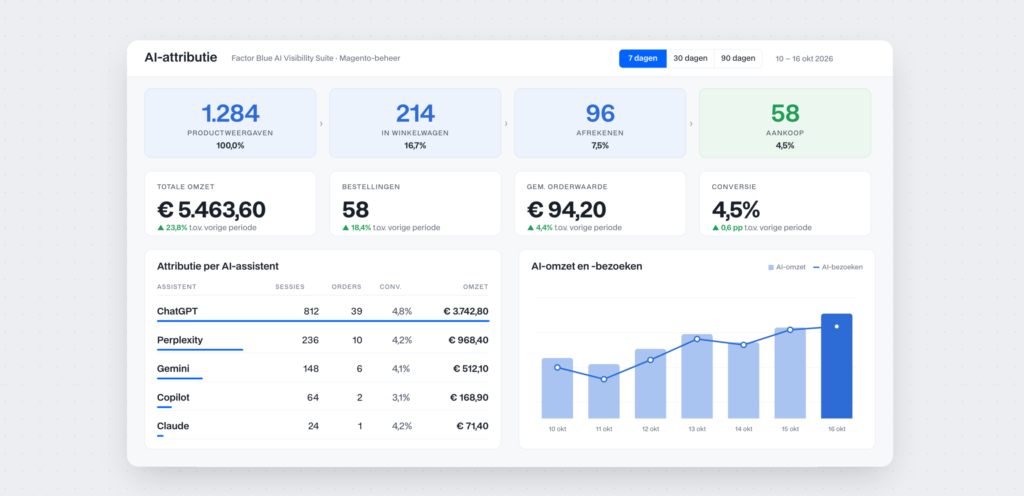
AI agents aren’t recommending your products? Here’s how to boost the visibility of your Magento online store

Worried that an update might break your Magento shop? Here’s how to safely update Magento extensions

What it really takes to have a product configurator developed within an organization

Three quotes, three very different prices: what an Magento B2B online store costs


Done with your current agency: here’s how the transition of your Magento management works

The license is free, but the migration isn’t: what “ Hyvä ” means for your Magento online store

A Custom Price for Every Customer: What This Means for Your Magento B2B Online Store

Cloned in just a few hours: the number of AI-generated copies of online stores is growing

Digital Product Passport (DPP): What Does This Mean for Your Product Data and PIM?