- E-commerce, Magento B2B
A Custom Price for Every Customer: What This Means for Your Magento B2B Online Store
In a consumer online store, there’s a single price listed for each product. Everyone sees the same amount, everyone places orders the same way, and no one needs to log in to see the price.
For a wholesaler, things work differently. A B2B online store isn’t just a B2C online store with a login added. Customer A pays 12.40 euros, Customer B pays 9.75 euros because they have an annual contract, and Customer C doesn’t see the product at all because it’s not in their product range.
That one question—what price does this customer see?—explains almost everything that makes a B2B web store more complicated than a consumer store. Other requirements we frequently encounter include: login functionality, customer groups, tiered pricing, integration with your ERP system, and a check to verify whether the customer is still authorized to place orders.
This article walks through that process. What a B2B online store at Magento can do—and when it’s the right choice.
What Sets a B2B Online Store Apart
Almost all the features that wholesalers need stem from customer relationships. Customer-specific prices or discount structures are often the starting point here. After logging in, each customer sees their own price, including volume discounts and agreements stored in your ERP. Without logging in, the customer sees the suggested retail prices or nothing at all.
This includes business accounts with multiple users. A buyer can place orders up to a certain amount, their colleague can only prepare a request, and the finance department views the invoices. That’s a single account with different permissions.
A limited catalog is more common than people think. A dealer may only see their own brands, and an end customer may not see dealer prices. In Magento , you can configure this on a per-customer-group basis.
Quotes are a necessary part of the process when you don’t sell everything from a price list. The customer creates a request, your sales representative adjusts the price, and the customer places the order with a single click. That saves an email exchange per order.
Quick ordering saves the most time of all. Regular customers order roughly the same items every week. For them, a field where they can type in item numbers or upload a CSV file is faster than clicking through a catalog.
Credit checks at checkout prevent awkward conversations later on. The store checks for any outstanding invoices and either blocks the order or puts it on hold.
Why the price should come from your ERP
Some functionalities rely on data that you already maintain elsewhere. The price agreement with Customer B is stored in your ERP. Inventory levels are stored in your ERP or your WMS. The credit limit is listed on the customer record in your ERP.
Once you start managing that data in your online store as well, you’re faced with two conflicting sets of information. That works for a while, but eventually it doesn’t. Someone adjusts a price in one system, forgets to update the other, and a customer places an order at the wrong price.
A good data integration is therefore not merely the final step of the project. Systems such as Microsoft Business Central, Exact, AFAS, and many others can be integrated with Magento.
When Magento is the right choice
Magento It is built for complexity. You’ll see this as soon as any of the aforementioned features apply to you.
You have thousands to tens of thousands of products, with variants, packaging units, and attributes that vary by customer.
You have dozens to hundreds of customer groups, each with their own prices, or you work with dealers who, in turn, serve their own customers.
You sell to both businesses and consumers, or in multiple countries, and you want to do so from a single backend installation.
You already have an existing system landscape—ERP, PIM, WMS—and it’s not realistic to replace it just because you want an online store.
Your online revenue is business-critical. If the store is down for even a day, it costs a lot of money.
In addition, Magento is open source. The code belongs to you; you can switch providers, and you’re not tied to a SaaS vendor that dictates the rules.
When Magento is not the right choice
This is the part most agencies won’t tell you. In certain situations, Magento is the wrong choice.
If you have a few hundred products and all prices are the same for everyone, you’re paying for complexity you’ll never use.
If you don’t have an ERP system, or if your product data is scattered across Excel files, you’ll need to address that first. Building an online store on top of disorganized data creates problems for your customers.
If you don’t have a budget for ongoing maintenance, then Magento is not suitable. Magento requires security updates, version updates, and someone to monitor it. Without these, a new store will become a risk within two years.
If you want to go live within six weeks, “ Magento ” won’t fit into that timeline. Expect four to six months for a B2B project involving data integrations.
Cost and timeline
A B2B online store at Magento typically costs between 50,000 and 150,000 euros to build. The turnaround time is usually four to six months.
Then comes the ongoing portion. Management, security updates, monitoring, and further development cost 1,795 euros per month at Factor Blue, depending on the amount of ongoing development required. Hosting is billed separately.
How to Make the Right Choice
Three questions usually provide a clear answer within half an hour.
How many different prices are there for the same item? If the answer is one, then you don’t need a B2B platform. If the answer is more than one, then you do.
Where can you find accurate information about products, prices, inventory, and customers? If that information resides in a system separate from the online store, then a Magento B2B online store is right for you.
What happens if the store goes down for a day? If that would seriously cost you revenue, it’s worth considering Magento .
What is a Magento B2B online store?
An Magento B2B online store is a store on Magento or Adobe Commerce designed for business customers, featuring customer-specific pricing, multi-user business accounts, quote requests, and an integration with the ERP system from which prices and inventory are sourced.
How much does a B2B online store cost at Magento?
A B2B online store at Magento typically costs between 50,000 and 150,000 euros in development costs, plus, at Factor Blue, starting at 1,795 per month for management and ongoing development. Hosting is an additional cost. Bandwidth is primarily determined by the number of integrations and the amount of customization.
How long does it take to build a Magento B2B online store?
A B2B project with an ERP integration typically takes four to six months. Projects without integrations are faster, while those involving a product configurator or multiple countries take longer.
What’s the difference between Open Source and Adobe Commerce for B2B?
Magento includes a B2B module with business accounts, quotes, and quick-order features, and requires an annual license fee. Open Source is free and does not include these features by default, but they can be added via modules. For many Dutch wholesalers, Open Source with a well-designed B2B setup is the most cost-effective option.
Can I connect Magento to my ERP?
Yes. Magento integrates with Microsoft Business Central, Exact, and AFAS, among others, either directly or via an integration platform. In practice, the integration determines whether the online store will function properly, so treat it as part of the project and not as an afterthought.
When is Magento too complex for a B2B online store?
Magento It’s too heavy if you have a few hundred items with a single price list, don’t use an ERP system, or don’t have a budget for ongoing maintenance. In those cases, a lighter platform or an ordering portal from your ERP vendor is more cost-effective.
Magento Isn’t it slow, though?
Yes. Hyvä is a front end for Magento that makes the store noticeably faster, and it also works for B2B stores with a login wall and customer-specific pricing. It replaces the standard Magento front end, so any existing front-end customizations will need to be rebuilt.
How much maintenance does Magento require?
Magento It requires ongoing maintenance: security patches, version upgrades, monitoring, and performance management. That is the cost of ownership, and it is also the main reason not to switch if you do not want to allocate a budget for it. We include this in a fixed monthly fee through our partnership packages, so it’s predictable and there are no surprises on the invoice.
Does “ Hyvä ” also work for B2B online stores?
Stay on Shopify if you sell a straightforward consumer product range, don’t have complex system integrations, and don’t want to allocate a structural budget for maintenance. Even if your current store is doing exactly what it’s supposed to do, staying put is the better decision: a migration costs money, time, and attention, and offers little benefit without a specific bottleneck. Magento only becomes worth considering if you’re hitting the platform’s limits or if your platform costs are growing faster than your margin.
Related articles
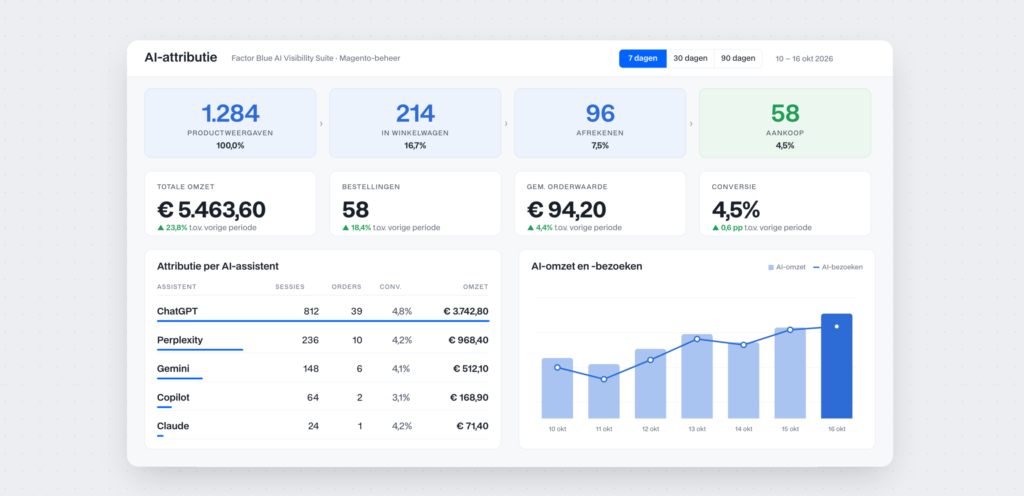
AI agents aren’t recommending your products? Here’s how to boost the visibility of your Magento online store

Worried that an update might break your Magento shop? Here’s how to safely update Magento extensions

What it really takes to have a product configurator developed within an organization

Three quotes, three very different prices: what an Magento B2B online store costs


Done with your current agency: here’s how the transition of your Magento management works

The license is free, but the migration isn’t: what “ Hyvä ” means for your Magento online store


Cloned in just a few hours: the number of AI-generated copies of online stores is growing

Digital Product Passport (DPP): What Does This Mean for Your Product Data and PIM?

One year after the EAA: not a single major online store is fully accessible