- AI, Magento B2B
What agentic commerce means for your Magento B2B online store
A buyer who orders the same fifty items every month will no longer need to log in to do so in the future. He tells an AI agent what is needed, and that assistant places the order with the supplier who can deliver. That is agentic commerce: not a person using an online store, but software purchasing on behalf of a person.
The protocol for this already exists and has been public since September 2025. Adobe committed to it in February 2026. However, nothing is operational in the Netherlands yet, and the specification is missing precisely the part that a Dutch wholesaler would rely on.
What is agentic commerce, and what is the agentic commerce protocol?
Agentic commerce is a purchase in which an AI agent acts on behalf of a buyer—searching, comparing, ordering, and paying—without the buyer having to click through a web store themselves. The Agentic Commerce Protocol (ACP) is the open standard that describes how such an agent and a seller communicate with each other.
ACP is maintained by OpenAI and Stripe, is licensed under the Apache 2.0 license, and has been publicly available since September 2025. The specification is still under development.
ACP is not the only option. Google has its own protocol, and on February 18, 2026, Adobe announced that Adobe Commerce will support both that protocol and ACP, in addition to its existing support for the Agent Payments Protocol.
How does placing an order through an AI agent work?
The agent displays the order screen; your online store handles the work behind the scenes. ACP defines five REST endpoints that the seller hosts themselves: start a session, retrieve the status, update the session, complete with payment, and cancel.
The seller remains the merchant of record. This is stated literally in the documentation for sellers: you calculate all amounts—including prices, discounts, sales tax, and shipping—you manage inventory, you process payments through your own provider, and you handle delivery. The AI agent is explicitly not the merchant of record and will not be assigned that role.
Payment is processed via a token rather than through card details. Stripe issues a Shared Payment Token for this purpose that is tied to a merchant and an order total, ensuring that the agent never obtains the buyer’s payment details. You may also use the protocol with another payment provider; Stripe is simply the first to appear to be offering such a token. However, many payment service providers will follow suit.
For a wholesaler, one detail is more important than the rest: you can accept or reject transactions by agent, per transaction, or based on your own logic. This means your system does not have to accept an order from an unknown party.
What does the B2B protocol include?
The announcements focus on consumers. However, the technical specifications do indeed include B2B functionalities.
Payment terms are included as a fixed field. The payment details include a `payment_terms` field with the values `immediate`, `net_15`, `net_30`, `net_60`, and `net_90`, plus a due date. In addition, there is a field for the purchase order number and a flag indicating that approval is required, and the session status has the value “pending_approval.” An order that must first be approved by a budget holder therefore fits within the model.
Company data is also included. The protocol features a CompanyInfo object containing the company name, VAT or tax ID number, department, and cost center. For VAT exemption, there is a separate object with a certificate number and a type, where “resale,” “exempt_organization,” and “government” are the permitted values.
One thing is missing, and it’s precisely the feature that many B2B online stores rely on. There is a field stating that a buyer must log in, and there is an error code `requires_sign_in`, but no mechanism is described for a restricted catalog with customer-specific prices. The product feed in the protocol is a push of your catalog to the agent, and it says nothing about customer-specific prices. Anyone who sells exclusively at negotiated prices behind a login will find that the current specification does not provide sufficient information.
Is this already working in the Netherlands?
No. Instant Checkout in ChatGPT went live in September 2025 for users in the United States.
No official source mentions the Netherlands, the European Union, or a European rollout. It merely states that access will be expanded to more countries over time. Dutch payment methods such as iDEA (Wero), SEPA direct debit, or purchase on account do not appear in the specifications; the only payment method specifically mentioned is Stripe’s Link.
Furthermore, implementing the protocol is not the same as being discoverable. The administrators say so themselves: each AI platform manages its own admission process, and anyone who wants to appear in ChatGPT must apply. The mechanisms by which AI platforms can identify which companies have implemented ACP are still under development.
Nothing is known about costs. None of the official sources mention a percentage, commission, or fee for sellers.
What would you need to build on Magento to participate?
Today: a custom layer on top of your shop. Without standard support from Magento (we haven’t seen any information about this for the open-source edition yet), this boils down to five endpoints that you host and maintain yourself, a public discovery document at /.well-known/acp.json, a product feed that you push to the agent, and a list of your capabilities in every response you send back. Add to that a version header and mandatory idempotency keys, so that a repeated request doesn’t result in two orders.
We at Factor Blue are already working on developing the first module based on the specifications we have. However, we are also unable to test it at this time.
Why this already has something to do with your product data
An agent buys what it can read. That is the only part of this story that is definitely worthwhile, regardless of which protocol wins: a catalog in which every item has a complete set of attributes—including unit, package quantity, availability, and delivery time—and in which that data is consistent across your ERP, your PIM, and your online store.
Traffic trends are now measurable. There is significantly more traffic coming from AI when the product content and context are in order.
The questions are coming in anyway. In September and October 2026, our site’s Search Console recorded eleven Dutch-language search queries about agentic commerce and AI at Magento —all formulated as complete sentences rather than as keywords. This is evidence of Google AI Mode, and it means that people are now asking an AI about this.
Agentic commerce does not fix a messy catalog—it will only expose it more quickly—which is why it’s a good idea to critically review your product data in preparation.
What is agentic commerce?
Agentic commerce is a purchase in which an AI agent searches, compares, orders, and pays on behalf of a buyer, without the buyer having to click through a web store themselves. The seller remains responsible for pricing, inventory, payment, and delivery.
What is the agentic commerce protocol, and do I need to support it?
The Agentic Commerce Protocol is the open standard that describes how an AI agent and an online store communicate with each other. It is maintained by OpenAI and Stripe, is licensed under the Apache 2.0 license, and has been publicly available since September 2025. Support for this protocol is not currently necessary for Dutch online stores: no platform is running on it here yet, and the protocol is still in beta.
Can I sell from the Netherlands using ChatGPT?
Not yet. Instant Checkout went live in September 2025 for ChatGPT users in the United States. No official source mentions the Netherlands or a European rollout date.
Does Magento support agentic commerce?
In February 2026, Adobe announced that Adobe Commerce will support the Agentic Commerce Protocol and Google’s protocol, in addition to its existing support for the Agent Payments Protocol. Adobe did not provide any further details and states that the company is working toward this goal. No information is available regarding “ Magento ” Open Source in this context. Factor Blue is currently developing its own module for this purpose.
Does agentic commerce work with customer-specific prices and a restricted catalog?
Not in the current specification. There is a field indicating that a buyer must log in and a corresponding error code, but no mechanism is described for a catalog with prices per customer. The product feed in the protocol is a push from your catalog to the agent without price differentiation per customer.
What does it cost to participate in agentic commerce?
That is not known. None of the official sources from the protocol administrators list a percentage, commission, or fee for sellers. The costs you can estimate are the development and maintenance of the five endpoints and the product feed, plus updates with each new version of the specification.
What should I do now to be prepared?
Ensure that your product data is readable and consistent across ERP, PIM, and the online store: complete attributes, fixed units, packaging quantities, reliable inventory, and delivery times per item. That effort pays off regardless of which protocol becomes the standard, and it’s the same foundation that improves your search engine visibility and your data connections.
If you want to know whether your catalog is ready for this, start by asking whether your inventory and prices are the same at all times in your ERP and in your online store. That is the fundamental question underlying every ERP integration, and the answer determines whether an agent can effectively work with your data.
Related articles
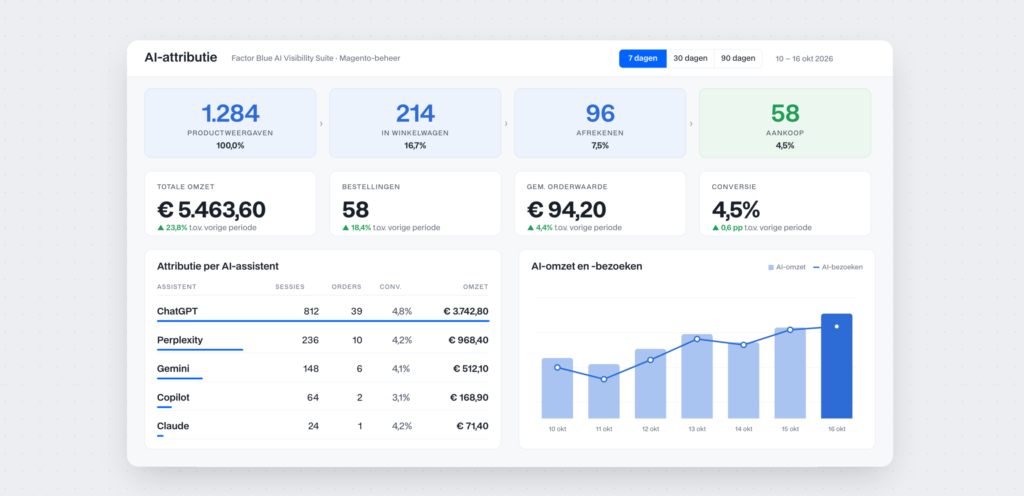
AI agents aren’t recommending your products? Here’s how to boost the visibility of your Magento online store

Worried that an update might break your Magento shop? Here’s how to safely update Magento extensions

What it really takes to have a product configurator developed within an organization

Three quotes, three very different prices: what an Magento B2B online store costs

Done with your current agency: here’s how the transition of your Magento management works

The license is free, but the migration isn’t: what “ Hyvä ” means for your Magento online store

A Custom Price for Every Customer: What This Means for Your Magento B2B Online Store


Cloned in just a few hours: the number of AI-generated copies of online stores is growing

Digital Product Passport (DPP): What Does This Mean for Your Product Data and PIM?