- E-commerce, Magento
Done with your current agency: here’s how the transition of your Magento management works
Most online store owners put off switching agencies for months. By then, the dissatisfaction has long been present. What holds them back is that no one can say exactly what the current agency has: the repository with the complete history, server access, licenses for paid modules, and the login credentials for the integration with the ERP.
Transferring a Magento online store is therefore similar to transferring a building. You can’t enter until you have all the keys, and you only realize which key is missing when you’re standing in front of a door. In a smooth transfer, the set of keys is complete.
In this article, we describe the steps you need to take, what an audit entails, how long the transfer takes, and what it costs.
When is it appropriate to switch to another Magento agency?
Switching providers is justified if the problem lies in the execution and has already been discussed a few times without any changes being made. The most common red flags are:
- Security patches remain unapplied for months, or you only find out after the fact that a patch was available
- All the knowledge about your online store is held by a single developer, and that developer has left
- Every request results in a post-calculation that you had no prior insight into
- No one can explain exactly how the integration with your ERP works
- You do not have access to the repository or to your own server environment
Switching agencies won’t solve everything. If the delays stem from you, they’ll follow you: unclear briefings and requirements that change halfway through will cause the same delays at a new agency.
Stick with them even if you end up switching platforms within six months. And avoid the peak season: if you switch agencies between October and January, your new partner will be entering the busiest weeks with an online store they’re only just getting to know.
A change in agencies takes four to six weeks before the new team can continue development independently.
What level of access should you have to your own Magento online store?
Transferring a Magento online store requires seven things. This is the set of keys, and the transfer isn’t complete until you have them all:
- the Git repository with the complete history, not a ZIP file containing the current code
- access to the hosting environment and the production server, via an account registered in your company’s name
- DNS management for your domain
- a Magento admin account with full privileges, also in your name
- the licenses and license keys for paid modules, registered to your company
- the login credentials and API keys for all integrations: ERP, PIM, payment provider, shipping carrier, email platform
- documentation of the custom solution built for you
Two key elements are most commonly missing. The first is the repository with version history: a team that only receives the current code cannot see why a change was made in the first place, which slows down every custom modification. The second is the module licenses, which are often held under the agency’s account and transfer over when switching providers.
Request this list before you cancel your contract. An agency with an active contract will cooperate more quickly than one that has already received your cancellation notice. Specify in your contract that the code and licenses are your property.
Why does an acquisition start with a code review?
A code review is a technical audit of the codebase, extensions, customizations, and security status, resulting in a report. Without that audit, a new agency takes over an online store whose condition it does not know, and in the first few months, this turns out to be work that no one had budgeted for.
The first question an audit answers is which version of Magento is running and whether it still receives security updates. Adobe Commerce and Magento Open Source 2.4.6 received regular support through August 11, 2026, and will continue to receive extended support through August 31, 2027. For version 2.4.7, regular support runs through May 31, 2027; for 2.4.8, through May 31, 2028; and for 2.4.9, through May 31, 2029. If your online store is running on version 2.4.5 or lower, it will no longer receive any security updates (Adobe, released versions) as of August 11, 2026. Adobe releases security patches approximately every two months, so a backlog can quickly accumulate.
In addition, an audit examines modifications to the core, extensions that overwrite one another, customizations without testing, and the PHP version on which the store runs. A code review and handover result in a documented report detailing the technical status, a prioritization of what needs to be addressed first, and recommendations for the way forward.
An honest audit may also result in the recommendation not to switch. If the online store is technically sound and the bottleneck lies in the collaboration, you can still choose to make the switch. If the store is running on an outdated version with a heavily customized core, the question is rather whether it can still be managed without a complete rebuild.
How long does it take to transfer Magento administration?
Once the agreement is in place, allow four to six weeks before a new team can independently continue developing your Magento online store. This period is divided into three phases that run partly in parallel.
The technical handover takes one to two weeks. During this time, hosting, repositories, credentials, and documentation are transferred; contact is established with the previous development team; and the development environment is set up. This is the stage where a missing key causes the most delays, because everything that follows depends on it.
The onboarding process then takes another one to two weeks. The new team familiarizes itself with the custom development, runs the store locally, implements a first minor change, and deploys it live to have gone through the entire process once. Only once that first deployment is successful do you know that the handover is complete.
Setting up an automated test suite for the critical workflows also takes one to two weeks. While this is not a mandatory part of a handover, it is where the effort pays off: a new team that is not yet familiar with the store benefits most from tests that confirm whether the checkout is still functioning properly.
During those four to six weeks, further development will proceed more slowly than usual. Therefore, do not schedule any campaigns, new integrations, or go-lives during this time.
How much does it cost to transfer your Magento management?
The transition involves three cost items, and only the first two can be estimated in advance.
The first step is the audit. A code review of a Magento online store costs 2,500 euros at Factor Blue, depending on the size of the installation, the number of extensions, and the amount of customization. You pay this amount once, and it is the only opportunity you’ll have to receive an independent assessment before committing.
The second aspect is the management itself. Fixed monthly management of a Magento online store starts at 1,795 euros per month, with more comprehensive packages available for stores that are undergoing ongoing structural development. The minimum contract term is six months, with the option to cancel free of charge within the first three months. Hosting is not included in the monthly fee.
The third item is the backlog of work that the audit reveals, which cannot be identified in advance. For a well-maintained online store, this is negligible. For a store that hasn’t received any patches in two years, it will take up the first few months of the contract.
How do you prevent the transfer from going wrong?
Almost all failed transfers go wrong in the same way: the contract is terminated before it is clear exactly what needs to be transferred. Seven things that prevent this:
- Request the complete list of access points while you are still a client of your current agency
- Have the audit conducted before signing a new contract, so that the report still has an impact
- Transfer the licenses for paid modules to your own company’s name as long as the old contract is still in effect
- Put in writing who will apply the security patches during the transition period, because that is precisely the vulnerability that allows hackers to breach online stores.
- Agree on a two-week overlap period during which the previous party remains available to answer questions
- Have the new team go live with one small change
- Avoid the period from October through January, unless your online store is actually quiet during that time
That sixth point is the real test. Only when a new team has independently deployed a change from its own development environment to production do you know that the set of keys is complete. Anything before that is just a list of login credentials that no one has verified to see if they work.
If you’re unsure whether switching is the right move in your situation, have a code review done first. A report on the state of your online store is also useful if you decide to stay with your current provider, because then you’ll know what to hold your current agency accountable for.
How much does it cost to have the management of a Magento online store taken over?
A code review of a Magento online store costs 2,500 euros at Factor Blue, depending on the size of the installation, the number of extensions, and the amount of customization. Fixed monthly maintenance then starts at 1,795 euros per month. The cost of the backlog of work revealed by the audit cannot be estimated in advance and varies by store.
How long does it take to transfer a Magento online store to another agency?
Expect four to six weeks from approval before a new team can continue development independently. The technical handover of hosting, repositories, and credentials takes one to two weeks; team onboarding takes another one to two weeks; and setting up an automated test suite takes one to two weeks.
Which agency can take over the management of my Magento online store?
Choose an agency that begins the project with a technical audit and shares the report with you before you sign a contract. Also, ask whether they work with fixed monthly fees or on a cost-reimbursement basis, and how quickly they respond to a system failure. A provider who quotes a price for maintenance without looking at the code doesn’t know what they’re taking on.
Do I own the code for my Magento online store?
That depends on your contract, and it’s the first sentence you should look up. Magento Open Source is free and open source, but the custom work built for you is subject to the agreement with your agency. If your contract doesn’t mention ownership, don’t assume you own it.
Can my current agency refuse to transfer the online store?
An agency is not allowed to withhold items that belong to you, but whether something belongs to you is determined by the contract, not by custom. Therefore, request the transfer in writing, including a list of what you expect and a deadline. Do this before you terminate the contract, because your position will be weaker afterward.
What should I ask my current Magento agency?
Nine items: the Git repository with full history, access to hosting and the production server, DNS management, a Magento admin account with full privileges, the licenses for paid modules, the login credentials and API keys for all integrations, the deployment procedure, the backups, and the documentation for the custom work. The repository with history and the module licenses are most often missing.
Will my version of Magento still receive security updates?
Magento Open Source and Adobe Commerce 2.4.5 and earlier will no longer receive security updates as of August 11, 2026. For 2.4.6, extended support runs through August 31, 2027, for version 2.4.7, regular support runs through May 31, 2027; for version 2.4.8, through May 31, 2028; and for version 2.4.9, through May 31, 2029. Adobe releases security patches approximately every two months.
Can I switch agencies without my online store going offline?
Yes, switching agencies does not require any downtime, because the online store continues to run on the same environment. Downtime only occurs if you switch hosting providers at the same time, and that is a separate process that you should avoid scheduling during the same weeks.
What happens to my hosting if I switch agencies?
Your hosting can remain where it is, provided the contract is in your own company’s name. If the hosting is in your current agency’s name, that constitutes a separate transfer that you must arrange in advance. At most agencies, hosting is not included in the monthly management fee.
When is it better to stick with your current Magento agency?
Stay the course if the delay is on your end, if you’re planning to switch platforms within six months anyway, or if you’re in the middle of your busiest period. Switching agencies takes four to six weeks for the new team to get up to speed, and that’s the price to pay for a structural problem, not for a conflict over a single project.
Related articles
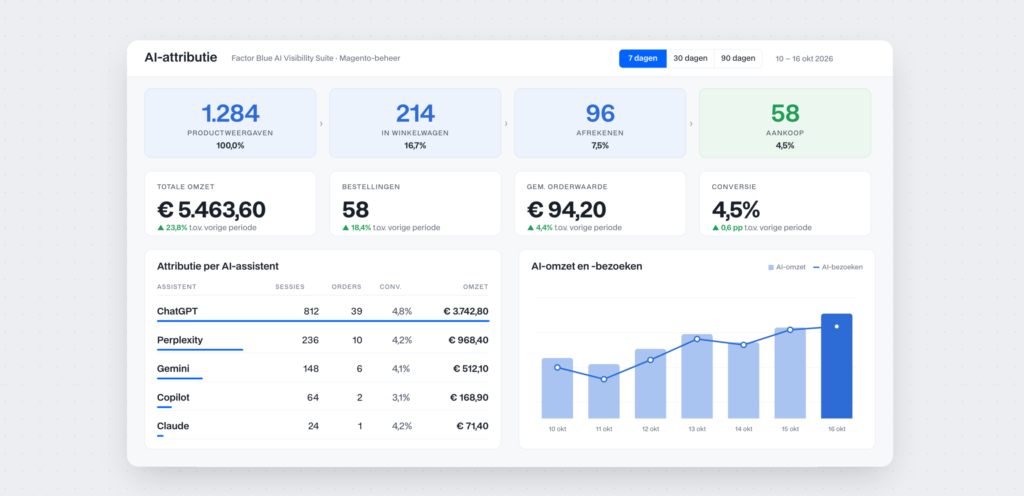
AI agents aren’t recommending your products? Here’s how to boost the visibility of your Magento online store

Worried that an update might break your Magento shop? Here’s how to safely update Magento extensions

What it really takes to have a product configurator developed within an organization

Three quotes, three very different prices: what an Magento B2B online store costs


The license is free, but the migration isn’t: what “ Hyvä ” means for your Magento online store

A Custom Price for Every Customer: What This Means for Your Magento B2B Online Store


Cloned in just a few hours: the number of AI-generated copies of online stores is growing

Digital Product Passport (DPP): What Does This Mean for Your Product Data and PIM?

One year after the EAA: not a single major online store is fully accessible